
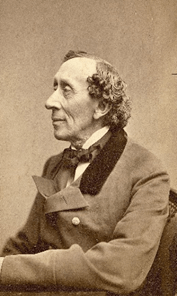
Hans Christian Andersen (1805-1875) was a Danish poet and writer best known for his children’s stories.
On one occasion he said that children’s stories are for children to sleep and adults to wake up.
But unfortunately, adults don’t wake up; and adolescents, who are at that bridge age where they are no longer children, but are not adults yet; although they like to act and issue opinions as if they already were: they neither fall asleep nor wake up.

In his story «The Emperor’s New Clothes» there is a clear moral message «what everyone says it’s true, it doesn’t have to be true»; but we continue to accept it as good whatever the majority thinks to be true; just for fear of looking like fools (so, no matter how much we open our eyes and our minds, and we continue seeing the emperor naked), but we prefer to join the general shouting. “How beautiful the Emperor’s new clothes are!”
It is just pure fear, because we know that, although it is said that «In the country of the blind, the one-eyed man is king» we know very well that «In the country of the blind, the one-eyed man is killed»; because no one blinded by illusions that accommodate their ego, can like to be shown reality; exactly the same as it happened with those who lived in the Cave described by Plato.
That is why it is so easy to turn a lie into truth, it is simply planted in the right mind: usually the weakest and dumbest, needing to appear to be big and great, so that it immediately spreads through similar minds and, step by step, go reaching superior minds that will give it the necessary academic nuance so that it becomes a dogma.

That is populism, both the kind you see around whereever you look at. Populism that Carlo Lorenzo Filippo Giovanni Lorenzini (1826 – 1890) Italian journalist and satirist, very critical of politics, several times censured by the Grand Duke of Tuscany, warned us about.
Under the pseudonym Carlo Collodi he wrote the children’s story “Storia di un burattino. Le Avventure di Pinocchio” (Story of a puppet. The adventures of Pinocchio).

Pinocchio’s adventures begin as soon as Geppeto carves his feet, because immediately the puppet runs out to see the world. Geppetto catches up with him and scolds him right there, trying to educate him; but people see them and accuse Geppetto of being a bad father and a police officer puts him in jail. Does it ring a bell?
A cricket advises Pinocchio, but he resents being told what he has to do; he throws a hammer at him and kills him: «In the country of the blind,…»
Pinocchio goes to sleep near the fire and burns his feet at night; and it is that «Who plays with fire…»
There are many skills that Pinocchio lives by always wanting to do what he pleases and ignoring Geppetto, the blue fairy and… the talkative cricket that reappears.
But the Fox and the Cat convince him to go to the land of toys and sweets. Certainly, he has a great time there: lots of toys, attractions and sweets of all kinds; but, after a while, he’s going to speak and he brays. He has ears and a donkey’s tail! He has turned into a donkey!
Do you see any similarity with today’s world, full of all the toys and attractions that enchant us and how, from puppets we become donkeys? Carlo Collodi already warned us 140 years ago.
Finally, that conceited and irresponsible wooden “thing” becomes a real child, thanks to understanding and admitting his stupidity and managing to overcome fancies and populisms by acting with love, honour, truth and virtue.
How much of each of these qualities is left?
I think that there is a lot, but those who still have a high percentage of them do nothing or just move by inertia; with which, that minority (which in 8 thousand million beings are too many beings), with a love only for themselves, for their own (race, nation, religion, politics), with an honour that only justifies their selfishness, with their lies made truths and a total lack of virtue because their feeling of insecurity, and of inferiority does not allow them to be virtuous; so, they destroy the lives of others.
As Emmanuel Todd demonstrates in «The Fool and the Proletarian»: everyone who has a tendency to totalitarianism, a need to dominate others, to move human beings as if they were chess pawns, can be a foreman or can have a lot of power or a huge amount of money, but he is a poor sick person, schizophrenic and paranoid.
 Pablo J.Luis Molinero