

Archaeology and newnesses
During many centuries, everything known about the origin of humankind was based on the diverse cosmogonies in different cultures across the globe. In the Middle East and Europe, Semitic tradition and Greek mythology predominated; in both, humans are seen as a limited copy of the Supreme Being, creator of all. In Europe, which was predominantly Christian, the only accepted truth was that which could be deduced from the Bible, according to which:
- 1) God, in six days, created everything that exists, including humans.
- 2) From the created human couple, a generational sequence of individuals arises, culminating in a Flood from which only Noah and his three sons and wives (Shem, Ham, and Japheth) survive.
- 3) Among the sons of Shem (therefore, the Semites) is Eber, and from him arise the Eberieus[1] (later turned to «Hebrews»), whose principal patriarch, Abraham (Ibrahim in Islam), departs from Ur, a city in Sumer.
- 4) Not knowing where the first couple was created, nor where Eden or Paradise was located, from which they were expelled; but since Abraham came from Sumer, it has always been considered that humankind originated in that geographical area and spread from there to the rest of the world.
- 5) Consequently, for centuries (until the 19th century) it was widely believed that all the inhabitants, ethnicities, and cultures known in Europe had undoubtedly come from Asia.
- 6) Taking the creation of the first human as our starting point, and considering the lifespans of those early patriarchs, especially when they had their first child, we would conclude that humans were created 6,000 years ago. However, if we start with Joseph, son of Jacob in Egypt, historically associated with the Fourteenth Dynasty of Egypt, and Moses, historically placed in the 14th or 13th centuries BC, counting backward using the data provided by the Bible itself, but in a more logical than mathematical way, we would find that, according to the Bible, humans were created between 6,000 and 11,000 years ago.
[1] In another article we will speak about the development and scope of this word and its relationship with Hispania.
That was the general feeling until the 19th century (19), since our interest in ancient times did not go beyond the biblical history of the Hebrews, Alexander the Great, the Greeks, the Romans and the events after the fall of their empire. Until the mid-19th century, the only work done relating to earlier times was the restoration of monuments and structures from recent antiquity.
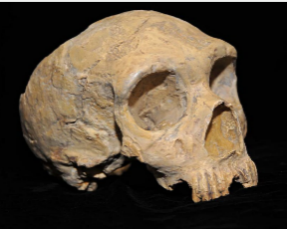
Occasionally, carved stones were found, which were considered insignificant, and human bones were taken to belong to someone more or less contemporary who had died there; as was the case in 1848 with the skull found in Forbes Quarry (Gibraltar)… seen and then discarded.
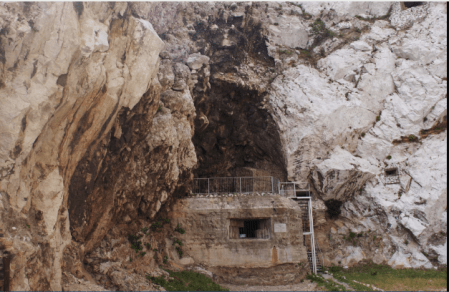
In 1859, Charles Darwin published his book «On the Origin of Species,» which caused a minor upheaval, as the prevailing idea had always been that God created all animals with a simple «Let there be.» However, with the influence of the Enlightenment and Logic still present, and considering the notion that «The ways of the Lord are inscrutable» and that for God time has no value, a second being as insignificant as thousands of years, there was no problem in admitting that this divine «Let there be» was a process of creation with subsequent continuous evolution and improvement. Although some religious positions (both individual and collective) interpreted the Bible as saying that God’s act was simply a «Let there be,» period.
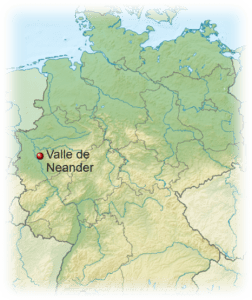
By 1866, new remains had already been found in the Trou de la Paulette cave (Belgium) and in the Neander Valley (Neanderthal in German). This skull did attract interest; however, as always, it was considered to belong to a human from a similar period, but with deformities; therefore, it was dubbed the (poor) deformed Neanderthal man; enough to pique the scientists’ interest in studying it.
In 1871, Darwin published his «The Descent of Man» and this book certainly caused an earthquake: Who was this madman who dared to say that the sacrosanct King of Creation, Man, God’s favorite work, was nothing more than an enhanced ape?
The findings and conclusions reached by scientists were met with a negative reaction from the masses, leading to the saying that: «Field archaeologists dig in garbage, laboratory archaeologists write garbage«.
However, scientists also began to acknowledge human evolution; therefore, that skull from the Neander Valley was not that of a poor, deformed man, but a human from a stage prior to us in the evolution described by Darwin; so, that species was called Homo neanderthalensis or Neanderthal Man. It was confirmed that the remains previously found in Gibraltar and Belgium were also of the Neanderthal species, but it continued to be called by this name even though the first one discovered, almost 20 years earlier, was the one from Gibraltar[1].
[1] This proves that being the first is one thing, but being shared, becoming a point of reference, and having utility for the rest of humanity is another. We’ll return to this point when we discuss whether or not Columbus actually discovered America, as some would have it.
Even admitting this, the idea that humans originated in southern Mesopotamia and migrated from there to Europe remained valid… …until, in Afar (Ethiopia), on November 24, 1974, the skull and almost complete skeleton of a young woman were discovered. She was beginning to transition from an ape, showing clear signs of being a pre-human biped. Her discoverers, the American Donald Johanson and the Frenchmen Yves Coppens and Maurice Taieb, were listening to the Beatles’ song «Lucy in the Sky with Diamonds» when they un-earthed the fossil and decided to name this young pre-human woman, who lived between 3.5 and 3.2 million years ago, Lucy; they also considered her the Eve of humanity.
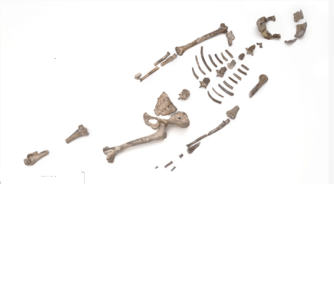
Lucy was beginning to transition from an ape, showing clear signs of being a pre-human biped. Her discoverers, the American Donald Johanson and the Frenchmen Yves Coppens and Maurice Taieb, were listening to the Beatles’ song «Lucy in the Sky with Diamonds» when they un-earthed the fossil and decided to name this young pre-human woman, who lived between 3.5 and 3.2 million years ago, Lucy; they also considered her the Eve of humanity.
This once again shook the foundations of beliefs accepted for centuries and supported by what was written in the Bible: Adam and Eve were not from southern Mesopotamia, but from Africa and on top of that (clashing with the extolled idea that the white race was the absolute supremacy), our first parents were black, we descended from the (despised) black race.
If, instead of being negative and stubborn, we try to give credit to the Bible and credit to science, there’s no problem understanding that the Bible says nothing about Adam, Eve, and Paradise being in Mesopotamia. That was a theory only because Abraham left Ur, and there’s also no problem in the fact that, precisely because of that evolution, black humans «improved» to white humans… and so it was accepted that pre-human hominids advanced along the Nile Valley, reached what later became Egypt, turned right, then south to Mesopotamia where the Sumerian culture arose; and, millennia later, some moved as far as Europe… Everyone’s happy…
But suddenly, in Atapuerca, near Burgos (Spain), five distinct stages of human evolution appear, all together, at staggered levels. It’s the only place in the world where this phenomenon has occurred: something that completely changes the landscape, which some won’t like to admit.

