The surprise in Atapuerca
As I have already stated in previous «Hispania, Mother and Refuge», linking Bible and Science, the prevailing view regarding the movements of pre-humans as they advanced and discovered new lands was this:
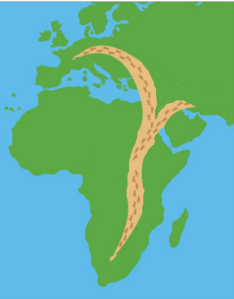
From what is now Ethiopia and Kenya, one group went south (to present-day South Africa) and another to north, following the course of the Nile River. Since the arid Sahara Desert lay to the west, they went east. Having crossed the Sinai Peninsula, some went northward and others eastward; the latter settled between the Tigris and Euphrates rivers, north of the Persian Gulf; where, many, but quite many millennia later, the Sumerian civilization would be created; more or less at the same time as the Egyptian civilization in the Nile Delta.
Those who went north reached the Bosphorus Strait and from there populated Europe, the last lands to be occupied being the British Isles and the Hispanic Peninsula.
Thus, everyone was happy; although for some, it was still difficult to accept that Eve was a black African girl, more ape than woman. They also struggled, though less so now, to understand that when Moses wrote Genesis[1] and said that God created one thing in one day and another in another day, and so on for six days, what he really meant was «stage» or «phase,» not 24-hour days[2].
[1] It is generally accepted that the first five books (Pentateuch) were written by Moses; but in his time (1400 BC) Hebrew writing did not yet exist, which arose, inspired by Phoenician writing, 300 years after Moses; therefore, it remains a mystery who wrote the first 5 books of the Bible.
[2] The sequence in which the Bible describes the creation of the different elements of the universe and the geology, flora, and fauna of the planet is in complete agreement with what science has been discovering. The only difference is that the Bible uses the term «day,» while science speaks of millions of years; but for God, everything is in the millions; we ourselves, each one of us, are a universe of 100 billion cells… …while we only see an individual.
The same fundamental principles still prevailed: what was recounted in the Bible, plus what was known about the Egyptian and Mesopotamian civilizations, but accepting, as inevitable, that the beginning of everything lay in some little blacky apes ones from Africa.
According to this view, it was clear that all the inhabitants of Europe came from the east.
However, something very important was overlooked: these fundamental principles were 8,000 years old, but Lucy and other fossils found in nearby areas, even 500 years older, were 2.8 million years old. Nobody wondered what happened during that very long time in between…
Well, it’s clear, such primitive beings, moving just out of necessity very occasionally, ended up reaching the north and in time created civilizations and moved on to Europe… But something very important was being overlooked: the ice ages.
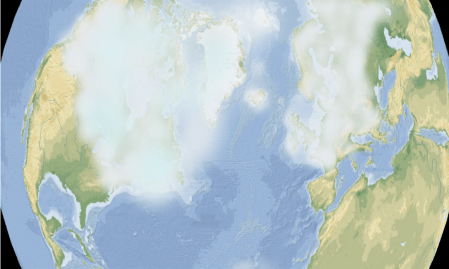
Since the time of Lucy and her neighbours, already beginning to stand out as hominids, several ice ages have occurred: one around 2,450,000 years before Present (BP) that lasted (give or take a week) about 350,000 years; another around 850,000 BP during 215,000 years; one around 580,000 BP for 160,000 years; one around 300,000 BP that lasted 140,000 years; and one from 110,000 BP to 14,000 BP, the most recent one to date.
All of these ice ages have been similar: the entire northern part of the American and Eurasian continents covered with enormous blocks of ice up to 4 km thick. at high altitudes, whose weight caused the ground to sink and, when the glaciation ended and large glaciers broke off, they eroded the land and formed lakes (the Great Lakes of North America, the Baltic Sea, the Caspian Sea, the Fjords, Lake Geneva, etc.). The southernmost areas of these vast ice sheets were covered in snow up to 30 or 40 metres thick.
In all cases, the lands south of the 43ºN parallel (south of the Pyrenees in the case of Hispa nia) enjoyed a very pleasant, almost tropical climate. Besides this, sea levels were 120 meters lower than they are today. That is to say, during the Ice Age, the only place in Europe where one could go and live under suitable conditions was Hispania, since even the Strait of Gibraltar was easy to cross.
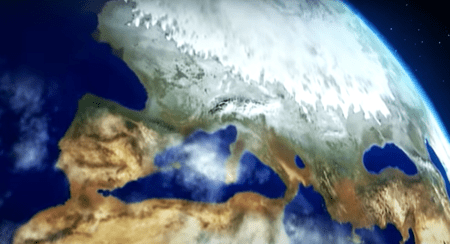
One could reach Europe through the Bosphorus Strait, but only the coasts of what is now Greece could be inhabited; all around were inhospitable snows leading nowhere suitable for life. The southern third of Italy was habitable, but there was no land route, and the voyage from North Africa to Sicily was too long for logs or rafts, although not impossible.
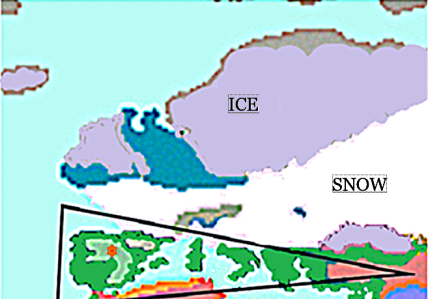
All this could confirm that humans did not migrate to Europe until after the end of the last Ice Age 14,000 years ago[1]…; however, an unexpected and surprising event has changed this scenario (long maintained with such “solid” argu- ments), and it has been the discovery at Atapuerca[2], 14 km from the city of Burgos.
[1] Even if some small group had managed to do so during interglacial periods, they would have frozen to death during the next ice age.
[2] Place marked on the map with a red dot, within the privileged, almost tropical zone, inside a forested peninsula full of life.
Atapuerca has yielded fossils from up to five different stages of human evolution; the only place in the world where such a discovery has been made.
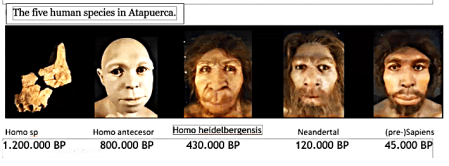
And it’s not just a single fossil from each group; but hundreds, even thousands, of remains have been found from the last four groups, more than 7,000 in the case of Homo antecesor, a group of human evolution unknown before Atapuerca. Besides human fossils, thousands of fossils of the fauna that existed in that area for hundreds of thousands of years before our era have been found.
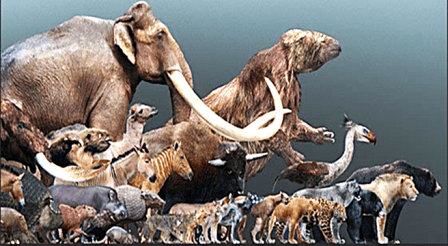
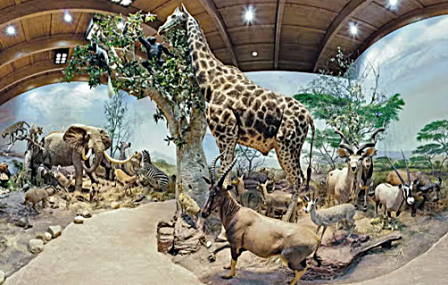
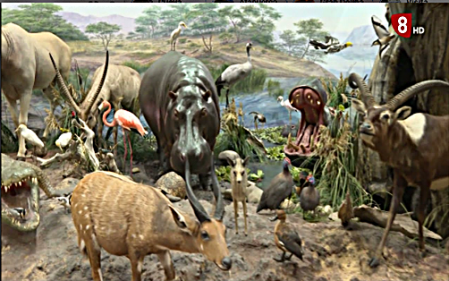
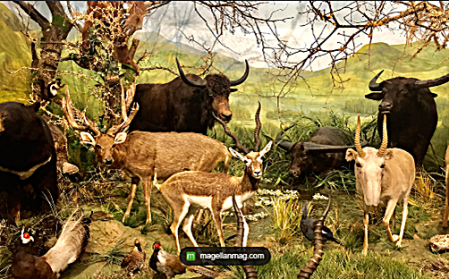
Representation, in the “Museum of Fauna” of Atapuerca, of the animals whose bones have been found at this site; several of them with clear signs of having been hunted, skinned, scraped and eaten by humans.